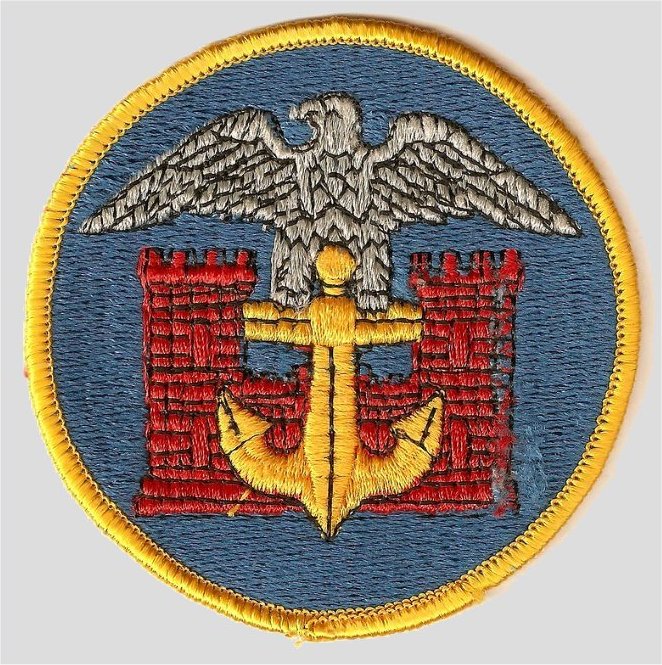
Patch worn by United States Army Corps of Engineers, Floating Plant Personnel.
--A note on the development of Mississippi River Dredges--
Engineers Far From Ordinary. The U.S. Army Corps of Engineers in St. Louis
"Perhaps what most promoted and enabled use of dredges was their development and endorsement by the Mississippi River Commission after 1892. In 1891, a delegation of ship captains
operating below St. Louis raised concerns that conditions on the river had deteriorated to the point where they impaired navigation. As a result, the commission created the
Committee on Dredges and Dredging in 1892 to research, prototype, and deploy dredges in the Lower Mississippi River. Suter and St. Louis civilian engineer Henry Flad were the initial
committee members, which eventually included Benjamin Harrod and Handbury. By the following year, the committee had developed the Dredge
Alpha which featured a pump and drag system
and discharge pipe extending aft. A mooring spud kept the dredge in place, allowing it to move back and forth over a bar. First used near Cape Girardeau in 1894 to clear a 1,600-foot
bar, the dredge was a huge advance in technology, but lacked sufficient power. A second model introduced in 1896, the Dredge Beta, used two pump engines and improved the discharge pipe.
After the 1896 Rivers and Harbors Act provided funding to build additional prototypes, the committee complete the Dredge Gamma later that year, which included more sophisticated pumps
and two intake lines and heads. A jet provided agitation to increase the effectiveness of the suction, and a 1,000-foot outtake line maximized distance to deposit areas. In 1897,
the committee introduced the Dredge Delta, which used a mechanical cutter on the suction head to break up soil. This was followed by the dredges
Epsilon and Zeta, which used jet and scraping agitation to breakup soil prior to suction. Wrhile
experimenting with design, the committee also tried various combinations of crew numbers and operation. With completion
of these prototypes, dredging entered maturity of design and operation.”
Engineers Far From Ordinary. The U.S. Army Corps of Engineers in St. Louis