Please report any broken links or trouble you might come across to the Webmaster. Please take a moment to let us know so that we can correct any problems and make your visit as enjoyable and as informative as possible.
NavSource Online: Service Ship Photo Archive
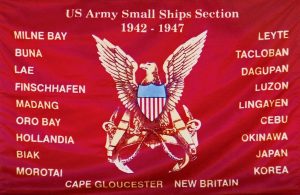
USAV FS-406
Precedence of awards is from top to bottom, left to right
Top Row - American Campaign Medal
Asiatic-Pacific Campaign Medal - World War II Victory Medal Philippines Liberation Medal

USAV FS-406 was manned by the US Coast Guard during World War II
Freight-Supply Vessel
Laid down in 1944 as the Design 381 Freight-Supply Vessel FS-406 for the US Army at Hickinbotham Bros. Stockton. CA.
Launched in 1944
Delivered to the US Army Quartermaster Corps in December 1944
Assigned to the US Army Transportation Corps
Commission USAV FS-406, December 1944, at San Francisco, CA. LT. T.E.F. Chandler, USCGR in command
USAV FS-406 was assigned to and operated in the Southwest and Western Pacific areas, including Biak, etc.
On July 1, 1945, FS-406 was underway in the Northeast Sulu Sea bound for Iloilo, Panay Island from Cebu, Philippines. She moored at Muala Pier, Panay Island at 1215
on that day loading 35 tons of empty oil drums for shipment to Tacloban, and departing the same date, anchoring off Maripipi Island for the night and proceeding through Junanbatas
Channel, FS-257, ahead of her, ran aground. FS-406 stood by and rendered assistance towing her off the beach at 1200 and then
proceeding to Tacloban Harbor. On the 5th she stood out of Tacloban Harbor for White Beach, Leyte Island and after unloading her cargo by barge returned to Tacloban. On the 14th
having loaded 325 tons of miscellaneous cargo she left Tacloban bound for Batangas, anchoring on the night of the 15th in the lea of BilhirIn Island and arriving at Batangas on the 17th.
On the 22nd with a return load she left Batangas for Manila arriving at anchorage on the 23rd and docking on the 25th. On the 31st she was loading 300 tons of miscellaneous cargo for Puerta Princessa, Palawan Island. During July, 1945, she steamed 703.8 miles, making a total of 17,535.3 miles steamed since her commissioning.
On 16 September 1945, while anchored at Hagushi, Okinawa with the steering assembly disabled by a typhoon on 11 September 1945, while en route from Tacloban to Hagushi, a report of
another typhoon which would pass close to the east of Okinawa was received. At 1300 on the 16th T.C. 95.5.2 cleared the harbor to weather the typhoon at sea, but small ships such as
FS-, LT-, and several Navy tankers and Liberty ships remained at anchor an the harbor. By 1100 on the 16th the wind had reached 25 knots coming from NE and the barometer read 29.148.
Sea watches were set and anchor chain veered to 100 fathoms in 15 fathoms of water 1 mile off shore. The engines were started and kept warm until she got underway, at 0410 on 17
September 1945. A jury steering gear was set up. By 1900 on the 16th the wind had reached 70 knots from the NE and the barometer read 28.87. The ship was rolling 15 degrees, but the
anchor did not appear to be dragging. By 2200 the wind had shifted and was coming from the NW at 70 knots while the barometer read 28.52. By 0200 on the 17th the wind had again shifted
to WNW with velocity at 70 knots, there being no protection from land with the wind from that direction. The ship was rolling and pitching and the anchor dragged slightly. By 0300 on
the 17th, the barometer had risen to 28.81. At 0410 in a deep pitch of the ship the stern came down on a reef and the ship immediately got underway at flank speed, the stern hitting the
reef again at 0413 and the anchor windlass being unable to take in the chain because of the heavy strain on it. The anchor chain, being welded in a pad-eye in the chain locker could not
be slipped and they proceeded dragging the port anchor and maneuvering among ships anchored in the harbor with the use of engines. At 0600 she dropped back on her anchor about 1.5 miles
off shore with both engines slow ahead. The wind and sea were still from the WNW with wind velocity at 70 knots, but the barometer had risen to 29.06. The ship was pitching heavily and
rolling more than 40 degrees. At 0730, having taken in the port anchor, she proceeded WNW heading into the wind, a difficult operation with the jury rig steering, necessitating constant
use of the engine for steering. At 0900 a visual message was sent to Navy tug #28 to stand by for assistance, the jury rig being inefficient for steering and there being heavy vibration from a bent propeller blade. At 1100 on the 17th the wind had decreased to 40 knots from the WNW and the barometer had risen to 29.40. She had proceeded pitching and rolling to Naha Harbor with Navy tug #28 standing by. She entered Naha Harbor at 1300 as wind decreased to 30 knots and barometer rose to 29.44. On the 18th an examination of hatches showed only a slight shift cargo in No. 1 hold, consisting of 90 tons of engineering supplies, but due to a shift in No. 2 hold the ship had a port list of 2 or 3 degrees, which could not be taken off with the starboard fuel and water tanks topped.
On 8 October 1945, while anchored in Naha, Okinawa, with the steering assembly still disabled and port propeller damaged from previous typhoons, a report was received that a typhoon
would pass close to Okinawa. All hatches ware secured and the chain veered to 60 fathoms port and 30 fathoms starboard. By 0800 on 9 October 1945, the wind had reached 25 knots and the
barometer read 29.02. By 1300 the wind was 80 knots and the barometer 28.64. At 1355 the anchor was noticed to be dragging and at 1400 preparations were made to get underway to take the
strain off the anchor chain. Due to high wind velocity and inefficiency of bent propeller she was unable to make headway and prevent dragging the anchor using flank speed on both
engines. At 1410, with her anchors still dragging, the ship was bearing down on a coral reef when it struck at 1425. By 1515 the generators were out of operation due to lack of water
pressure and at 1700 the wind had reached 150 knots with the barometer reading 28.70, the ship being high on the coral reef. The water had risen to a depth of 2 feet above the deck
plates in the engine room from holes in the hull. By 10 October the water was over the main engines and generators in the engine room, the lazarette was flooded to within 12 inches of
the weather deck and there was two feet of water in the after crew's quarters coming from fittings leading to the lazarette. The vessel was eventually given up as lost.
Final Disposition, sunk by typhoon, 8 October 1945
FS Specifications:
Displacement (As Built) 557 gross tons
Length (As Built) 177'
Beam 32'
Draft 14'
Speed 12 kts
Freight Capacity unknown
Complement unknown
Armament unknown
Propulsion
two 500hp GM Cleveland Division 6-278A 6-cyl V6 diesel engines
twin screws
Click On Image
For Full Size Image | Size |
Image Description |
Contributed
By |
| There are no images of USAV FS-406 available at NavSource |
There is no history record available for USAV FS-406 at NavSource
This page is created and maintained by Gary P. Priolo

|
Last Updated 17 November 2023