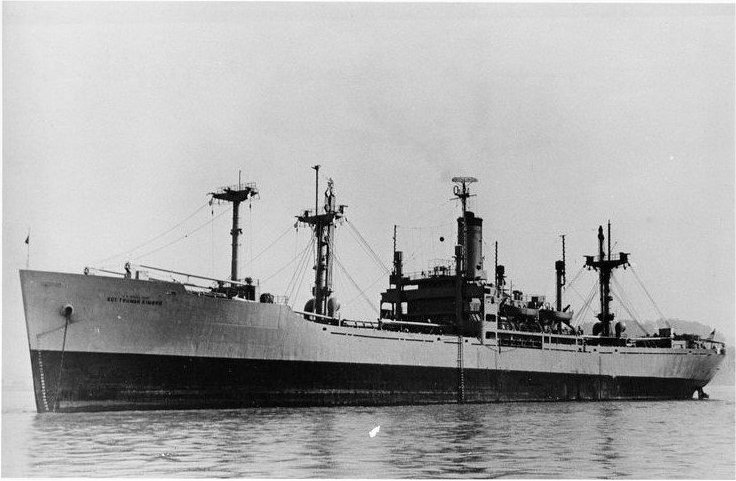
Click On Image
For Full Size Image | Size |
Image Description |
Source |
 |
65k |
Namesake
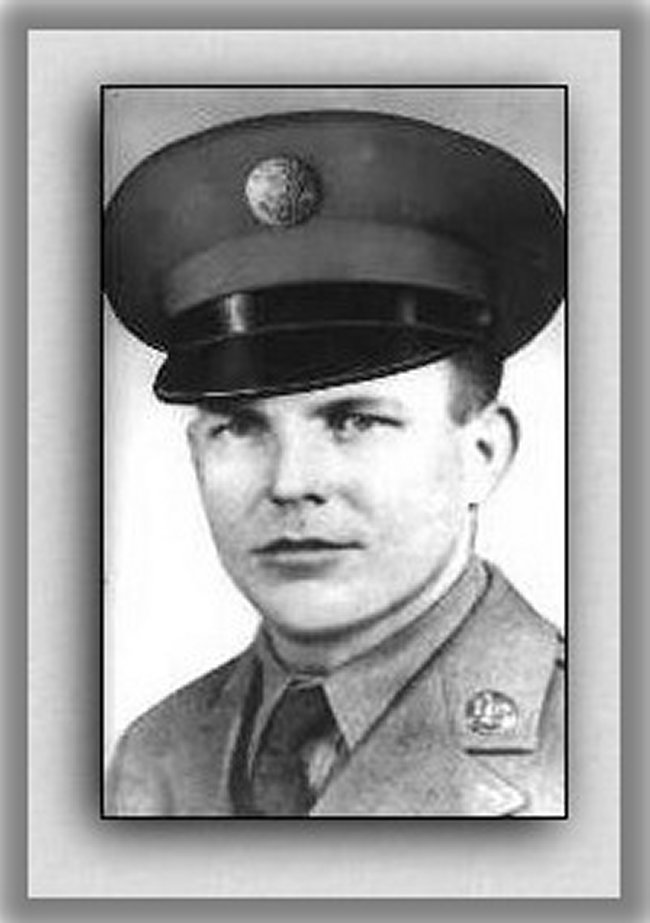
Technician Fourth Grade Truman Kimbro, a Texan serving in Company C, 2d Engineer Combat Battalion, 2d Infantry Division, was killed near Rocherath, Belgium, on 19 December 1944. On that date, during the early phase of General von Runstedt's counter offensive now known as the “Battle of the Bulge,” Kimbro led a squad to mine a vital crossroads near Rocherath. After several attempts to reach the objective, which was protected by an enemy tank and approximately 20 infantrymen, he left his men in a protected position and, laden with mines, crawled toward the crossroads. Although severely wounded, he continued on through withering fire; planted his mines; then started back to his squad's position. Technician Fourth Grade Kimbro was killed as he left the crossroads. His actions, however, by delaying the advance of enemy armor, protected the rear of withdrawing columns. For his courage and sacrifice, Kimbro was posthumously awarded the Medal of Honor.
Photo: Medal of Honor Website |
Bill Gonyo |
 |
64k |
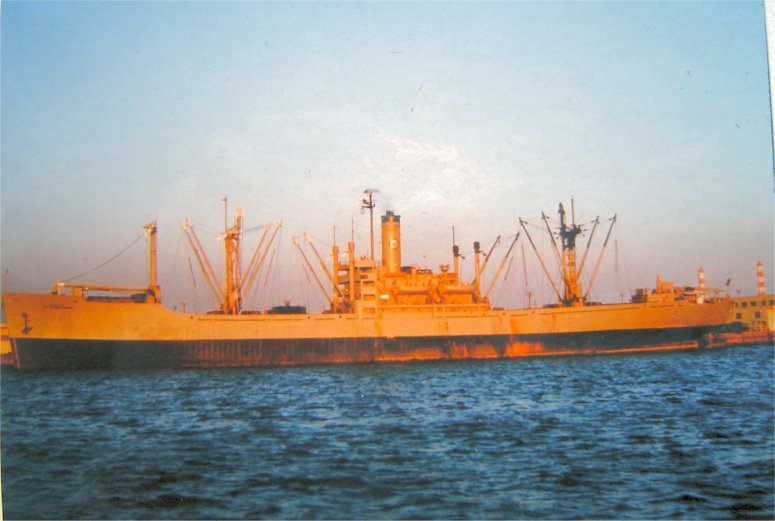
USNS Sgt. Truman Kimbro (T-AK-254) berthed at the US-Army pier, Yokohama, Japan, December 1973. |
Photo Gerhard L. Mueller-Debus |
 |
63k |
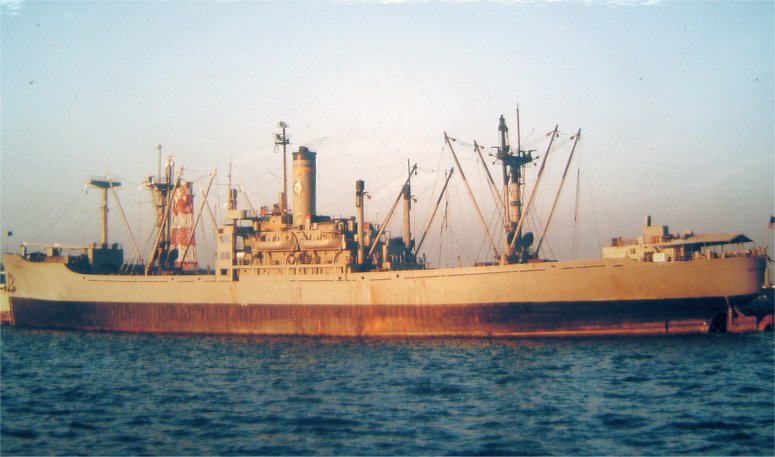
USNS Sgt. Truman Kimbro (T-AK-254) berthed at the US-Army pier, Yokohama, Japan, December 1973. |
Photo Gerhard L. Mueller-Debus |
0913025404 |
79k |
USNS Sgt. Truman Kimbro (T-AK-254) anchored at Yokohama, Japan, in 1975. |
Nicholas Tiberio |
0913025405 |
111k |
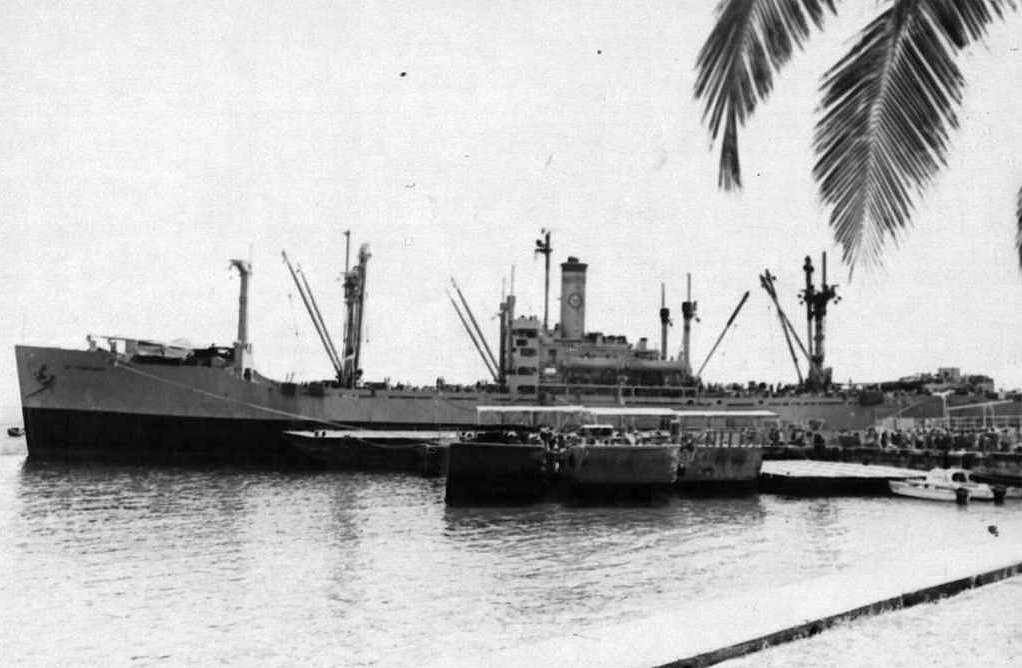
USNS Sgt. Truman Kimbro (T-AK-254) offloading Vietnamese refugees at Subic Bay, 5 May 1975.
Photo from www.picryl.com by www.wikimedia.org |
John Spivey |
0913025406 |
60k |
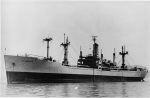
USNS Sgt. Truman Kimbro (T-AK-254) underway, date and location unknown. |
Nicholas Tiberio |
Photos by Robert H. McKay while supervising the transportation of a cargo of Nerve Gas and Tactical Nuclear Artillery shells from Guam to Port Chicago Naval Magazine in California
aboard USNS Sgt. Truman Kimbro (T-AK-254) circa February 1969.
Additional comments by Robert H. McKay
Something has bothered me about what I shared with you previously regarding the speed of this ship (the Sargent Truman Kimbro) as we crossed the Pacific Ocean from Agana Harbor, Guam to Port Chicago US Army Depot east of Oakland, CA. I will try to look further into it and update you with whatever I confirm/find out.
It may or may not be important, but I remember reading current online information about the Victory ship/MSTS Vessel Sargeant Truman Kimbro. I read somewhere that this ship was capable of speeds of around 14 or 15 knots. However, I VERY CLEARLY AND SPECIFICALLY remember that we travelled from Agana, Guam to Port Chicago (US Army Depot), CA at a maximum speed of around 3 or 4 knots/hour on the beautiful, aqua-green and warm Pacific Ocean until we reached the cold, steal-gray coastal waters off the west coast of California and that this trip took about 13 full days to make this journey. When we reached the cold, steal-gray Pacific Ocean off the western coast of California, the ship was supposedly able to speed along about 1 knot faster. As I recall I was told by the Captain or by the First Mate, that was a speed approaching but maybe never really reaching about 5 knots/hour.
Additionally, I very clearly remember how disappointed I felt in my continuously sea-sick body when I saw at least one and possibly two ocean liners serially appear a long way off in the distance behind this vessel and pass us as if we were not making any progress at all. This occurred not long after - possibly within one day after we left Agana Harbor, Guam. I also remember that seagulls continually flew behind the fantail seemingly for days on end without ever seeming to rest and possibly for the entire trip to Oakland, CA (unless they rested at night), and also how many flying fish really almost seemed to fly out of the sea behind us. I remember a man the crew nick-named the "Roadrunner" who seemed to continually climb and descend ladders around the engine(s?) checking various glass-covered gauges and who's job was to keep the ship's engine(s? running. I remember being told this man never seemed to leave the ship and that, as a consequence, all of his clothing including his shoes was given to him by members of the crew.
I remember walking on a walkway which ran alongside the propeller shaft in the bowels of the ship, and how I was stunned to see a man with a long-handled shovel scraping multiple shovels-full of rust from the inside walls of the ship. And I also remember being stunned to see sea-water pour seemingly un-impeaded into this raceway where the propeller drive-shaft exited the ship. I realized then that the ship would certainly sink if the ship's engine(s) ever stopped.
I remember perhaps eating the entire ship's supply of saltines to stave off the sea-sickness I felt and watching the gravy that bathed our food slosh around my dinner plate which was held in place on the surface of the metal rimmed table by a wet tablecloth. The metal rim of the table extended about 1/2" above the surface of the table
|
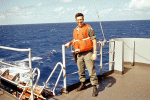
2LT Bob McKay - Classified mission aboard USNS Sargent Truman Kimbro
| 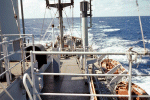
USNS Sargent Truman Kimbro looking aft during classified mission
| 
USNS Sargeant Truman Kimbro looking foward classified mission
| 
SP4 Bob Canter seasick on guard duty aboard USNS Sargeant Truman Kimbro during classified mission
| 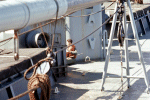
SP4 Robert Soares on guard duty aboard USNS Sargeant Truman Kimbro during classified mission
| 
Part of guard detail on forward deck of USNS Sargeant Truman Kimbro during classified mission
|
 USNS Sgt. Truman Kimbro (T-AK-254)
 USAT Sgt. Truman Kimbro (1947 - 1950)